

Mathematics
“Mathematics is not just about numbers - it’s about wonder, discovery, and the joy of finding patterns in the world around us.”
Marcus du Sautoy, mathematician
Intent
At Liphook Federation, our mathematics curriculum is ambitious, coherent, and designed for mastery. It enables pupils to develop deep, connected knowledge through carefully sequenced learning that builds cumulatively over time. Pupils develop fluency, reasoning, and problem-solving skills in a structured and progressive way.
We prioritise equity and inclusion by implementing strategies such as pre-teaching vocabulary and concepts, practising number fluency, and adapting teaching to provide appropriate scaffolding or challenge.
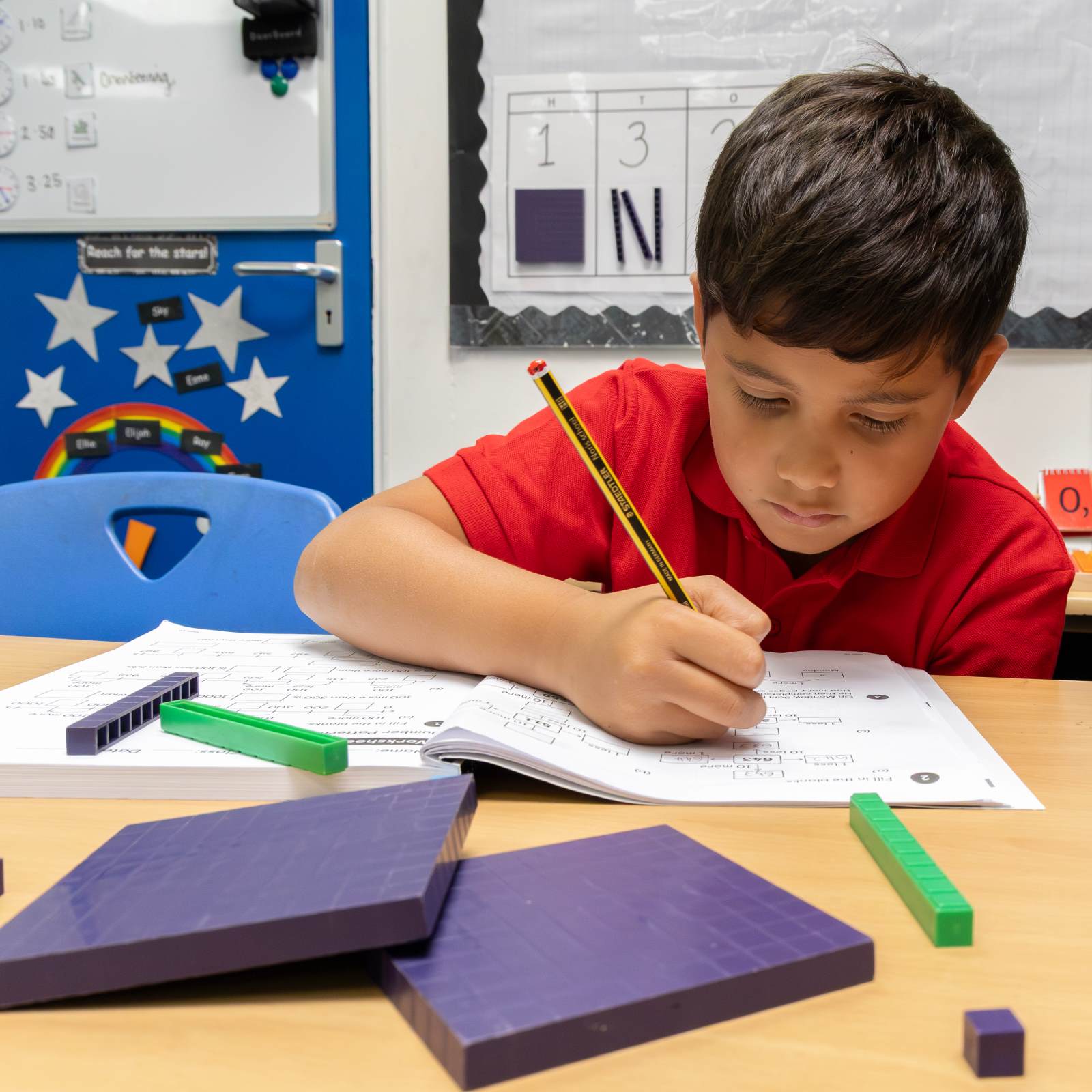
Our approach follows the Concrete–Pictorial–Abstract (CPA) model and incorporates real-life contexts to strengthen conceptual understanding. Pupils are encouraged to think and talk like mathematicians—reasoning verbally and in writing—and to apply their knowledge confidently across the curriculum.
Implementation
Mathematics is delivered through the Maths — No Problem! mastery approach, developed in Singapore. The curriculum is organised into discrete areas:
- Number (place value, addition, subtraction, multiplication, division, fractions, decimals, ratio)
- Measurement (weight, length, time)
- Geometry (properties of shape, position, direction)
- Statistics
We ensure pupils make rich connections across mathematical ideas to develop fluency, reasoning, and problem-solving skills, enabling them to apply their knowledge in other subjects such as science.
Lessons follow the gradual release model—I do, we do, you do—and a consistent structure designed to develop fluency, reasoning, and problem-solving:
- Explore
Each lesson begins with a rich problem for pupils to explore collaboratively using concrete resources. This promotes oracy, mathematical thinking, and multiple strategies. - Master (Structured Discussion)
The teacher leads a discussion to draw out strategies, address misconceptions, and introduce new concepts using the CPA approach. - Guided Practice
Pupils practise strategies with scaffolding and variation. Teachers provide support and check understanding before independent work. - Independent Practice
Pupils apply learning independently in workbooks designed with variation to deepen understanding. Tasks are accessible yet challenging, supporting mastery for all learners. - Journaling
Pupils use five main types of journaling to develop mathematical thinking and reasoning: - Descriptive – Explaining methods or concepts clearly
- Evaluative – Comparing strategies and making judgements
- Creative – Exploring multiple representations and solutions
- Investigative – Open-ended tasks and pattern finding
- Formative – Ongoing reflection and assessment of learning
Journaling builds deeper conceptual understanding, develops mathematical language, and provides teachers with insight into how pupils link ideas and apply knowledge in non-standard contexts.
Assessment
Regular assessment, both within the lesson and during end of unit reviews, enables early intervention.
Support
Where pupils need additional support, targeted interventions are used. The emphasis is on children keeping up as far as possible.
Challenge
Further challenge opportunities include NRICH, I See Reasoning, , I See Problem Solving, Maths - No Problem teasers, and Learning By Questions. Pupils also have the opportunity to take part in the Primary Maths Challenge across Key Stage 2.
Use of Technology
Apps such as Numbots and Times Tables Rock Stars are used to practise number fluency. Learning By Questions is used in the Junior School and tailors questions to the pace and attainment of each pupil, ensuring that they progress at their own speed and do not get left behind. Teachers use AI to customise maths problems across various topics and create engaging and interactive maths quizzes
Impact
By the time pupils leave the Federation, they:
- Demonstrate fluency in fundamental mathematical facts and procedures
- Show deep conceptual understanding, enabling them to make connections and apply knowledge flexibly
- Use reasoning and problem-solving skills to tackle routine and non-routine problems with confidence
- Retain and recall knowledge effectively, supporting progression to secondary education
- Exhibit positive attitudes towards mathematics, with curiosity and enjoyment that underpin lifelong learning